
John’s Story
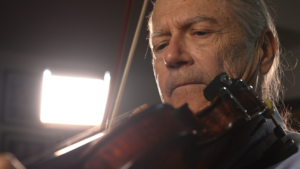
John was born in London and raised on a farm that has been in his family for seven generations. Coming from a musically gifted household, he and his family formed the Allen Family Reunion, a bluegrass band that captivated audiences at festivals throughout the early 1980s. Trained classically on the violin, John ultimately found his true calling as a fiddler in country and folk music, a path that led him to international stages and a celebrated career. He later became a six-time Juno Award–winning member of the country band Prairie Oyster, whose innovative sound helped elevate Canadian country music on the world stage and earned the group induction into both the Canadian Country Music Hall of Fame and the London Forest City Music Hall of Fame.
John’s musical talents carried him across every province and territory in Canada, 29 American states, and on tours throughout Europe, the Middle East, Africa and China. Despite his global travels and success, John has always called his London family farm home.
In September 2018, the Allen Family Reunion was invited to Northern Ireland to represent Canada at an international music festival. During the trip, John noticed he was becoming unusually fatigued. After returning home, his condition worsened while he was touring with The Good Brothers.
“I was struggling with shortness of breath and knew I was in trouble,” he recalls. “I was really nervous and stressed about not knowing what was wrong with me.”
John visited his family doctor and nurse practitioner, who ordered an echocardiogram that revealed a potential diagnosis of AL amyloidosis — a rare and difficult-to-diagnose condition caused by abnormal proteins in the blood. In John’s case, these proteins had settled in his heart. Hematologist Dr. Martha Louzada joined his care team, and John underwent weeks of outpatient chemotherapy to eliminate the rogue proteins. A subsequent heart biopsy confirmed he was experiencing heart failure as a result of the disease.
In August 2019, cardiologist Dr. Ryan Davey admitted John to University Hospital for further testing to determine whether he was a candidate for a heart transplant. During his second day in hospital, John experienced two cardiac arrests — dying twice.
“The team was able to save my life because I was only metres away from the cardiac surgery intensive care unit,” John says. “If this had happened anywhere else, I wouldn’t have made it.”
John spent the remainder of August and September recovering, waiting and hoping for a transplant match, surrounded by an incredible support system that included his wife Wendy, along with family and friends. On the evening of September 27, 2019, cardiac surgeon Dr. Dave Nagpal delivered the long-awaited news: a donor heart had been found.
As he was being prepared for surgery, John remembers looking outside and seeing a large rainbow fill the sky — a moment he felt could only be a good sign. The transplant was a success, and more than four and a half years later, John is thriving. He is a proud grandfather to two grandchildren and has returned to playing the fiddle.
“It is not lost on me that while our family was blessed with this miracle, another family was grieving a terrible loss,” John shares. “We will be forever grateful for their unselfish gift of life.”
Today, John is a passionate advocate for transplant awareness and organ donation. He serves as a committee member with New Canvas of Life, working to promote the importance of registering as an organ donor. Reflecting on his care, John speaks with deep gratitude about the team that saved his life.
“Here in London, a medium-sized city in southwestern Ontario, we are fortunate to have one of the finest transplant centres in Canada, if not the world,” he says. “The innovations, breakthroughs and advancements that happen here are truly amazing. LHSC punches well above its weight.”