
Chris’s Story
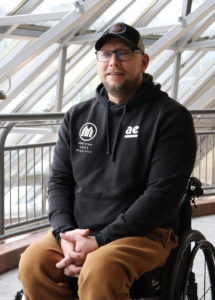
Chris Smith’s journey at St. Joseph’s Health Care London began in the quietest, most unexpected way imaginable. One night, he went to bed feeling completely healthy. The next morning, he woke up unable to move from the waist down. With no warning signs, no clear cause and still no clear diagnosis, Chris faced an abrupt, life-altering challenge.
From the beginning, the rehabilitation teams located at Parkwood Institute played a critical role in his recovery, helping him regain his mobility and confidence.
Born and raised in London, Chris has always been determined, competitive and resilient. After the loss of his mother, he stepped up to adopt and raise his three half-brothers. Today, he shares a blended family with his wife Emily, who he dubs as his “right hand” and strongest supporter, and her children, who have provided steady, loving support throughout his recovery journey.
Outside of rehab, Chris finds comfort and joy in the quieter moments – caring for his aquarium, spending time with friends and going on beach trips with his family and his trusted pal, Teddy the goldendoodle. Away from Parkwood, he also volunteers extensively at Western University, where he shares his experiences with student programs, and enjoys staying active through adaptive sports like wheelchair rugby.
“If I can help myself move forward, I can help others do the same,” he shares. “I volunteer because I want to give back. The team at Parkwood have done so much for me so wherever I can help, I want to as well.”
Chris approaches his recovery journey with effort and commitment each day. Using advanced equipment and technology located at Parkwood Institute, he has made progress in his ability to move his legs and his overall mobility. He uses the Lokomat, a robotic medical device that provides physiological and intensive rehabilitative gait training, and the battery-powered Ekso bionic exoskeleton, that improves and restores mobility and independence in patients with a neurological or muscular injury. Over time, these tools have helped him gradually build up his coordination and confidence.
One of the keys to his successful rehabilitation has been using a specialized treadmill that’s paired with a harness system to partially support a patient’s body weight.
“The treadmill allows patients to relearn stepping and walking patterns without having to support their full weight,” says Kristin Wanless, a physiotherapist in the spinal cord injury outpatient program. “Trainers work closely at the patient’s feet, legs and pelvis to guide movement and help the nervous system develop the ideal walking pattern.”
Chris credits his success to the personalized, compassionate care he receives.
“I feel like we’re part of the same team,” he says, reflecting on the staff who adapted therapy to his personality and supported him every step of the way.
For Chris, the ultimate thanks is through action – walking through the gym on his own with his crutches, pushing himself during every session on the body weight treadmill and proving the power of persistence, perspective and community.
