

Jaime’s Story
When Jaime was six years old, she was diagnosed with epilepsy. She experienced focal unaware seizures, which caused her to lose awareness of her surroundings, as well as tonic-clonic seizures, the type most commonly associated with full-body convulsions.
Jaime lived with epilepsy for years before eventually being referred to the Epilepsy Monitoring Unit (EMU) at University Hospital (UH). There, an electroencephalogram (EEG) and subdural electrodes placed into her skull helped doctors determine where her seizures were originating. The scars from that experience are still visible today—if you run your fingers along Jaime’s head, you can feel the indents.
When doctors told Jaime she was a candidate for brain surgery, she wasn’t nervous. Before the procedure, she met a man living with epilepsy who told her, “I have epilepsy and I’m driving now. One day, you’ll drive too.” His words gave Jaime hope, and she believed the surgery could change her life.
The neurosurgeons removed five centimetres of brain tissue, which stopped Jaime’s daytime seizures. However, she continued to experience nocturnal seizures during REM sleep. Waking up after one of these episodes was physically and mentally exhausting. Her head would ache, she would feel completely drained and her mind would be foggy. The following day was often a complete write-off. At her worst, Jaime was experiencing four or five nocturnal seizures every month.
After decades of managing these night-time seizures, Jaime returned to the EMU in 2022. This time, Dr. Ana Suller Marti and her team discovered that the seizures were coming from a deeper area of her brain called the insula. They recommended radiofrequency thermocoagulation, a procedure that uses heat to ablate tiny areas of brain tissue. Dr. Jonathan Lau, a neurosurgeon, performed an ablation of 19 contact points.
Recovery was not easy. When Jaime first returned home, she didn’t recognize her own house. She couldn’t even remember who her son, Christian, was. It was a frightening experience, but with time, she began to feel like herself again.
Today, Jaime is thrilled to say that she has been seizure-free at night for a year. The difference has been incredible. She has returned to work and is driving—just as the man she met years ago promised she would.
Jaime is deeply grateful to Dr. Suller Marti, Dr. Lau and the entire EMU team for their care and compassion. She credits them with helping change her life for the better.
Throughout her journey, Jaime’s husband, Adrian, and their son, Christian, have been her greatest sources of support. Christian even learned seizure first aid when he was just four years old. One night, he helped his mother through a seizure and then calmly went back to bed.
Jaime’s experience has also inspired her to support others living with epilepsy. She began mentoring people through their own challenges and founded the Epilepsy Support Centre for Windsor-Essex, which is now part of Epilepsy Southwestern Ontario. When Jaime realized there was little support available for people living with epilepsy in Windsor, she knew she had to do something.
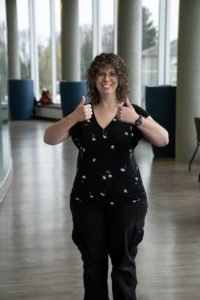
She also founded Thumbs Up for Epilepsy, an initiative where people paint their thumbnails purple to start conversations about epilepsy. What began as a simple way to raise awareness has grown into a global movement.
For Jaime, these initiatives are about giving others the hope she once received herself. She believes that when there is no hope, you have to give hope.
Her message to others living with epilepsy is simple and heartfelt: “Get your brain burnt—it’s worth it.”